
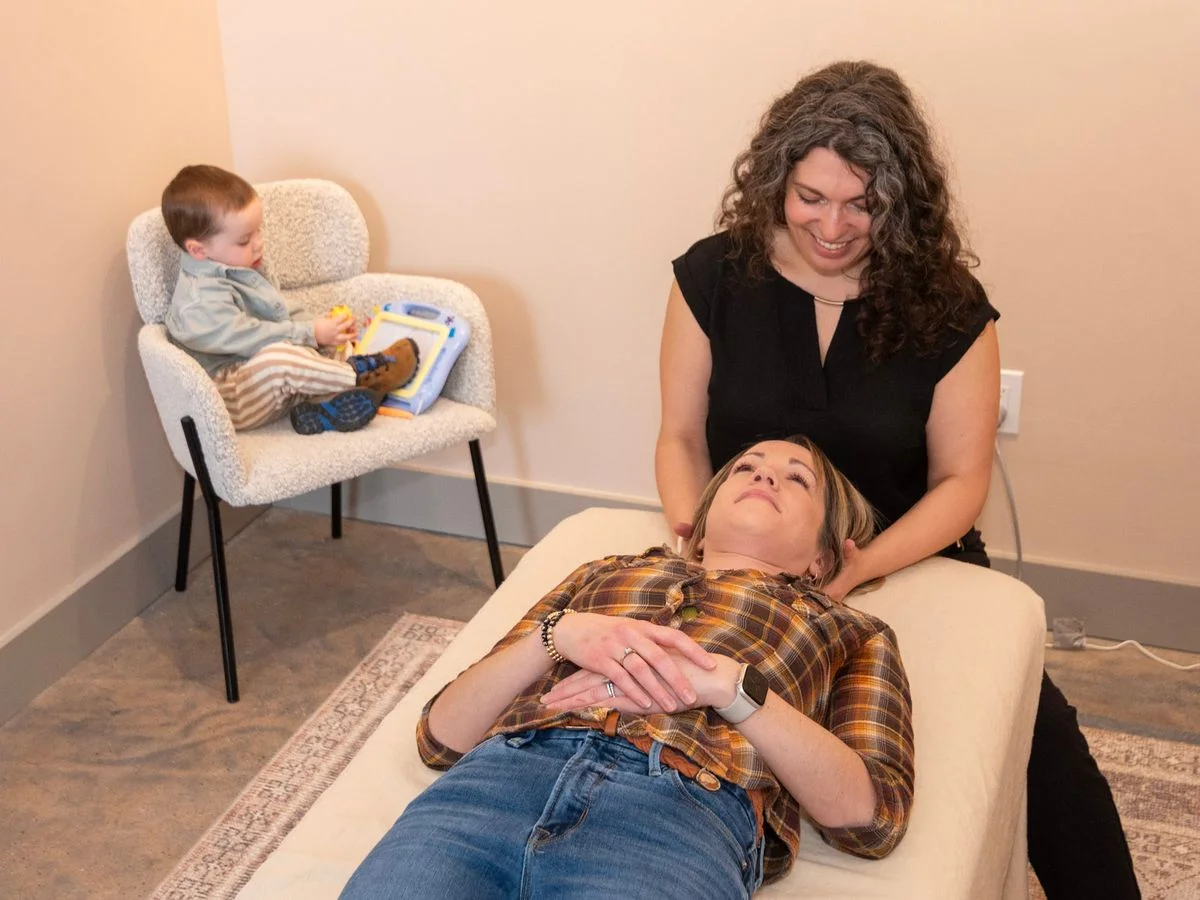
What "Postpartum Recovery" Actually Means
Pregnancy and birth are some of the most demanding physical events a body will ever go through. Your abdominal wall stretched. Your pelvic floor took weeks of pressure, then either delivered a baby or supported a major surgery. Your hormones shifted. Your nervous system rerouted around the realities of feeding and sleep.
The standard medical model gives you a six-week checkup and a "you're cleared for all activities" stamp. What it doesn't give you is rehabilitation. We do.
Symptoms That Mean You Need PT, Not "Time"
- Urinary leaking when you laugh, sneeze, cough, run, or jump
- Pain or discomfort during intimacy
- Heaviness, pressure, or bulging in the pelvis (signs of prolapse)
- A visible separation or bulge in the abdomen (diastasis recti)
- Painful, tight, or sensitive scar tissue from a C-section or perineal tear
- Lower back pain that didn't exist before pregnancy
- Constipation, hemorrhoids, or trouble emptying the bowel
- Feeling "disconnected" from your core, even months after delivery
- Wanting to return to running, lifting, or sport but unsure how to start safely
None of these are things you have to live with. None of them resolve on their own past a certain point. All of them respond to pelvic floor PT.
How We Treat Postpartum Recovery
1. Your first visit: a physical therapy evaluation
Your first visit is a 60-minute, one-on-one evaluation. We start by asking you about your history and your symptoms, and we ask you all about your bowel, bladder, and sexual function, as well as about any pelvic pain symptoms. We then evaluate how you move. We look at your spine movement, your pelvic mobility, and your hip strength. Next we will complete a full pelvic floor evaluation externally and either vaginally or rectally, as indicated. We are looking at the quality of the tissue in and around your pelvic floor as well as the strength, coordination, and mobility of your pelvic floor muscles. We check scar mobility, if any scars exist, and we evaluate your breath patterns and core integration, and look at how your body actually moves under load. You leave the first visit with a clear understanding of what's happening and a plan of care. Our next few visits continue to be part of the evaluation as we learn more about you, and we adapt as we learn how you respond to treatment.
2. Breath, Core, and Pelvic Floor Coordination
Most postpartum recovery begins with retraining and neuromuscular reeducation. We teach you to breathe again without a baby or two taking up all of your abdominal space. We reconnect you with your core and pelvic floor after both have been stretched and strained during pregnancy. We reintegrate your diaphragm, core, and pelvic floor so they work together again.
3. Scar and Tissue Work
C-section, perineal, and episiotomy scars often need direct manual therapy to mobilize, soften, and integrate. We do this work hands-on, and we teach you how to continue at home.
4. Progressive Loading
Early on, we start progressively loading you under real-world demands: lifting your baby out of the crib, carrying a car seat, getting back to the gym, eventually returning to running or sport. Our goal is to fully rehab you so you don't need us anymore (or hopefully, ever again).
5. Return to Running, Lifting, or Sport
If you're an athlete — even a recreational one — we build a return-to-sport progression for your specific goal. We want you getting back to your desired activity without any limitations, pain, leaks, or fear.
What's Different About Postpartum PT at Foundations
The single most common feedback we hear: "Why didn't my OB tell me about this sooner?" The standard postpartum care model in the U.S. doesn't include rehabilitation. We provide that. Every postpartum visit at Foundations is:
- A full 60 minutes, one-on-one with a doctoral-level trained physical therapist who specializes in the pelvic floor
- Designed around your specific recovery, not a template
- Trauma-informed — we move at your pace, and internal work is always optional
- Connected to your whole body — back, hips, core, pelvic floor, scars, movement patterns
- Goal-oriented — we build to where you want to be, not just symptom-free
What Your First Visit Looks Like
Every first visit is a full 60 minutes, one-on-one, at our Dobbs Ferry office. It starts with a conversation: how your delivery (or deliveries) went, any tearing or C-section, how feeding and sleep are affecting your body, what symptoms you're noticing, and what you want to get back to. There's no such thing as TMI here — the details you hesitate to say out loud are usually the ones that shape your plan.
Then we assess the whole system: back, hips, core, breath mechanics, movement patterns, strength, and mobility. If an internal pelvic floor assessment would add useful information, we'll explain exactly what it involves and why — and although it is never required, it is always helpful to get a clear and complete picture. You leave with a clear picture of what's going on and a plan, as well as a few things to start working on that day. For the full walkthrough, see what to expect at your first visit.
When Should You Start?
Any time. Research has shown that the earlier you start rehabilitation postpartum, the better and quicker your results — but it is never too late. We help moms months, years, or even decades after their pregnancies, with great results. Your six-week checkup with your obstetrician or midwife tells us that your tissue has healed enough for an internal exam, and we wait for that clearance before performing any internal evaluation or treatment in the postpartum patient. Before then, there is a lot we can do to help you recover and start your rehabilitation.
Frequently Asked Questions About Postpartum Recovery
How soon after giving birth can I start pelvic floor PT?
Anytime after the birth of your baby (and hopefully you have been seeing us during your pregnancy too!). The six-week OBGYN checkup tells you you're cleared for internal evaluation and treatment. It doesn't mean you're rehabilitated. Postpartum pelvic floor physical therapy is where the actual rebuilding happens — from healing scars and resolving leaks to running, lifting, and returning to activities you want to do without limitations.
I had a C-section. Do I still need pelvic floor PT?
Yes. Nine months of pregnancy loads the pelvic floor no matter how you deliver, and a C-section adds a major abdominal incision on top of it. Scar mobility, core reconnection, and pressure management matter just as much after a surgical birth.
Will I have to have an internal exam?
No. Internal assessment gives us the most direct read on pelvic floor strength and coordination, but it's always optional, always consent-based, and never required. Plenty of meaningful work happens externally, and you set the pace at every visit.
How many visits will I need?
It depends on many things: how your pregnancy and childbirth went, what your prior level of activity and strength was, and what your symptoms and goals are. You'll get an honest assessment and a plan at your first visit, and we reassess as you progress. The goal is your independence, not a permanent spot on your calendar.
Does insurance cover postpartum pelvic floor PT?
We submit out-of-network claims automatically on your behalf, so you're not stuck fighting with your insurer. HSA and FSA funds apply, and Medicare has its own process we handle for you. The details live on our insurance page.
I'm pregnant again — should I wait until after delivery?
No. Many symptoms can and should be treated during pregnancy, and the work you do before delivery — breath mechanics, pushing preparation, perineal mobility, strengthening and conditioning — carries directly into your recovery. Start with our pregnancy and birth prep page.
Related Conditions
Postpartum recovery often involves several overlapping conditions, each of which we treat:
- Diastasis recti — abdominal wall separation
- Urinary incontinence — leaking with activity or urgency
- Pelvic organ prolapse — heaviness, pressure, organ descent
- Painful intercourse — discomfort or pain with sex
- C-section scar pain or sensitivity
- Pelvic girdle pain or SI joint dysfunction