
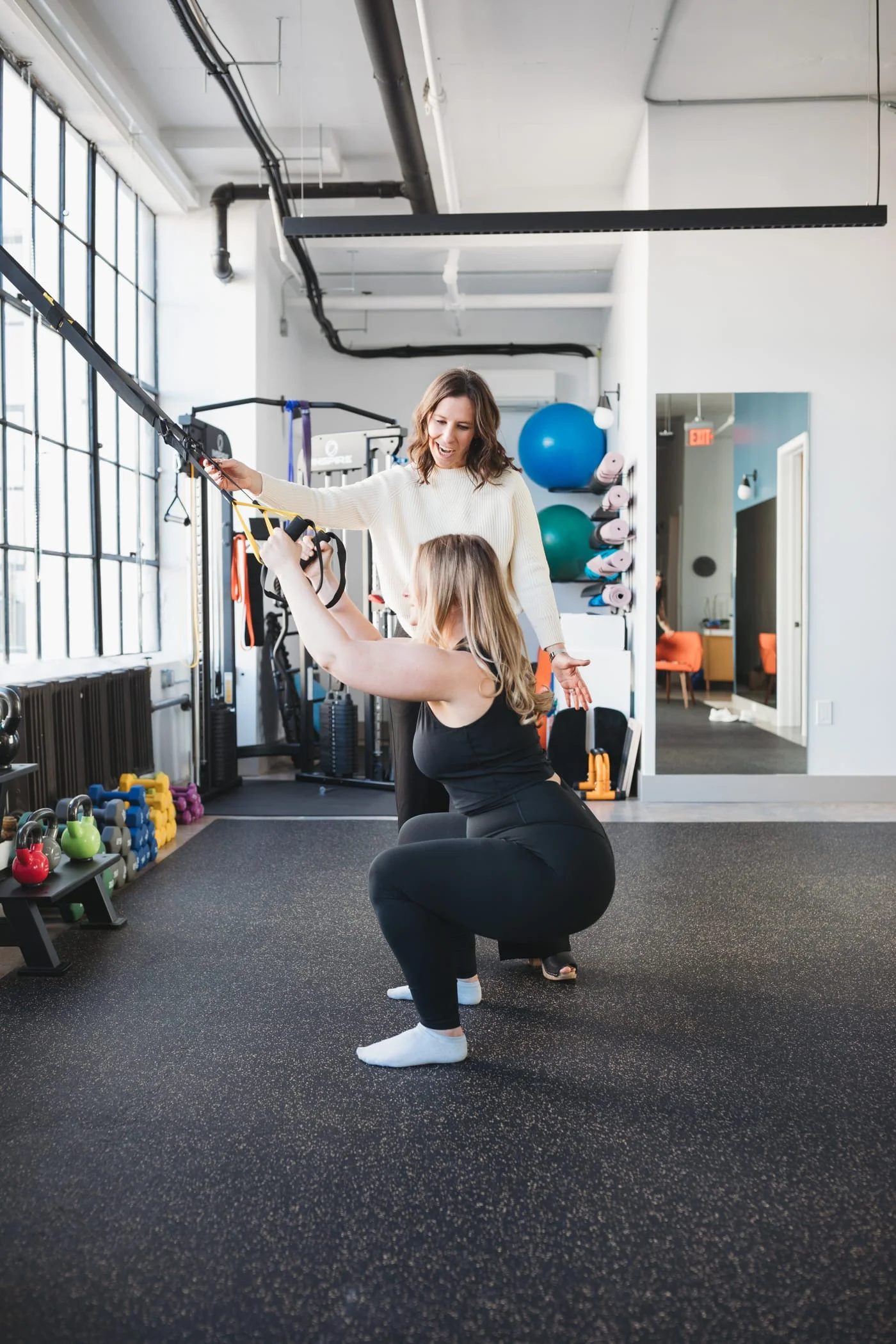
What Is Diastasis Recti?
During pregnancy, the abdominal wall stretches to accommodate a growing baby. The two sides of the rectus abdominis (your "six-pack" muscles) separate along the linea alba, the connective tissue that runs down the center of your abdomen. This separation is called diastasis recti.
After delivery, most separations resolve naturally within the first few months. For some, though, the gap persists — and if the muscles remain weak or poorly coordinated, it can contribute to back pain, pelvic floor dysfunction, poor posture, and poor abdominal wall support resulting in cosmetic changes (this is also true for anyone with core weakness, with or without a "gap").
Signs You May Have Diastasis Recti
- A gap you can feel between your abdominal muscles above or below your belly button (greater than 2 finger-widths is considered significant; anything below that is within normal limits, and you may even have had it prior to pregnancy without realizing it)
- Core weakness that seems to not be getting stronger despite exercise
- Pelvic floor symptoms (leaking, pressure) that haven't resolved
- A postpartum abdominal shape that doesn't match the rest of your recovery
- Difficulty getting out of bed or off the floor
- Fear of movements or exercises that you worry may worsen your separation
How We Treat It
Diastasis recti is rehabbed by any good exercise program that challenges your core — yes, that means anyone telling you that following their specific program will result in your gap reducing is selling you snake oil. Providers may claim they get great results, but numerous studies have shown your abdominal wall tone will improve with any exercise program that challenges your core muscles, and the gap will likely close on its own despite what you did or didn't do (yes, you can do planks, crunches and twists without the separation worsening... and you should!)
Effective treatment addresses the whole core system: your diaphragm, pelvic floor, abdominal wall and back muscles. Reducing fear and anxiety of movement, and targeted strengthening of the entire core and hip complex including the pelvic floor, is always part of the package.
1. Thorough Assessment
Your first visit includes an evaluation of your separation just to confirm you have one. Many times we check and the separation has already closed, or patients were told they have a separation when they don't. We measure your core strength and reaction under load, we assess the pelvic floor, and we look at how you breathe, stand, and move through your day. We perform a full postpartum assessment, as typically you are coming to us some time postpartum without having been fully rehabilitated (even if that was years or decades ago).
2. Breath and Core Coordination
Your pelvic floor and core need to be coordinated with your breath and with each other so one group of muscles is not impeding the other. Often this is done with the use of breath training (we may use a respiratory trainer) and biofeedback for pelvic floor engagement. We also look at where you are gripping, to undo any compensations you have created, to improve your feeling of strength and stability.
3. Progressive Loading
Once the coordination is there, we progressively load your core exercises to build muscle bulk and tone of the abdominal wall. We move to upright and standing exercises so your muscles are conditioned enough to do what you have to do. Recovery that only works on a mat is incomplete.
4. Return to Sport or Lifting
If you're — or want to be — a runner, CrossFitter, weightlifter, tennis player, or any kind of athlete, we build you back with progressions designed for your specific goals. Many patients return to their sport stronger than before, or start doing something they never thought was in their future.
What Your First Visit Looks Like
Your first visit is a full 60 minutes, one-on-one. We start by talking: your pregnancy and delivery history, what you've noticed in your abdomen, which movements feel weak or unstable, and what you've already tried. Then we measure. Diastasis is measured above, at, and below the navel for the amount of separation — but more important is assessing the depth and tension of the connective tissue, to ensure that you can transfer load across your abdominal wall and to assess the integrity of the tissue itself.
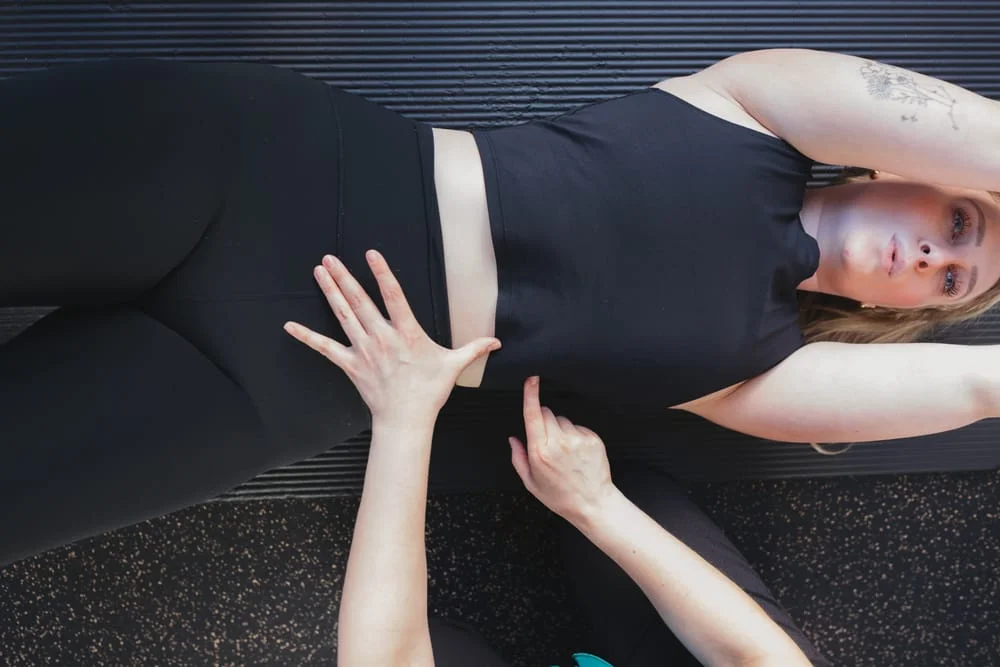
We do not remeasure the size of the separation at every session — we don't focus on the separation. Instead, we focus on your function, movement and strength. Whether the gap closes or not over time does not affect function unless there are tears/hernias along the linea alba which make it impossible to create tension uniformly across the separation. If that is the case, you may benefit from a surgical correction, and rehabilitation before and after surgery.
Diastasis recti rarely travels alone — it's one of the most common threads in postpartum recovery — so we screen the pelvic floor too. Any internal assessment is optional and consent-based, never required. But your core connection and strength is directly correlated with your pelvic floor strength and function, and we find results are significantly improved when incorporating this integral part of your pressure system. Here's what to expect at your first visit.
How We Measure Progress
We track what you can do and how well you can do it. Can you lift a laundry basket and carry it up and down the stairs feeling confident and strong? Can you hold your teething baby for hours on end when she needs comfort, without your back or hips aching? Can you run for the subway before the doors close without feeling a sense of instability, pressure, or leakage?
If the cosmetic situation is not where you want it, or the separation is genuinely not allowing you to engage your core effectively, surgery is a great option — and any rehab you do before or after will enhance your recovery and function. We work with many hernia surgeons that we can refer you to, who have different approaches depending on what you are looking for.
When to See a Pelvic Floor PT
Any time postpartum. Research shows meaningful improvement is possible even years after delivery. If you've "tried everything" and still have persistent core weakness, or if you are afraid of starting an exercise program or moving in certain ways for fear of worsening the separation, an evaluation is worth it. Book any time — we'll assess and give you honest feedback on what's realistic for your body.
Frequently Asked Questions About Diastasis Recti
How do I know if I have diastasis recti?
Lie on your back, lift your head, and feel along the midline of your abdomen with your fingertips — a soft gap or trench at, above, or below the navel greater than 2 fingertip-widths suggests a separation. An in-person assessment confirms width, depth, and tension.
Is some separation normal?
During pregnancy, yes — universally. The abdominal wall is supposed to separate to make room for a growing baby, and most of that resolves on its own in the first months postpartum. A surprising number of women who come in worried about a severe separation turn out to have little or none. A small separation is also normal at any time, even if you have never been pregnant. Measurement replaces fear with facts.
Can diastasis recti improve without surgery?
Most cases meaningfully improve with progressive core training, but some will improve just with time and getting back to your usual exercise program and activity. Surgery is a last resort reserved for a small minority of severe cases — and function usually improves well before, and matters more than, any change in the gap itself.
Are crunches and sit-ups really off-limits?
No. And "bulging" or "coning" means almost nothing, so don't be afraid of it, no matter what social media says. Push-ups, planks, twisting, sit-ups, crunches, lifting, and anything in between are all indicated and never contraindicated — you may have to build your strength and endurance to be able to do these higher-level abdominal exercises, but they are never off-limits and should not be something you are afraid of.
Will a belly binder or wrap fix it?
Support garments can be a reasonable short-term comfort tool in the early postpartum weeks, but passive compression doesn't teach your core to manage pressure or to get stronger — training does. If you're still relying on a wrap months after delivery, that's a sign the underlying system needs actual rehab, not more fabric.
Related Conditions
Diastasis recti often coexists with: