
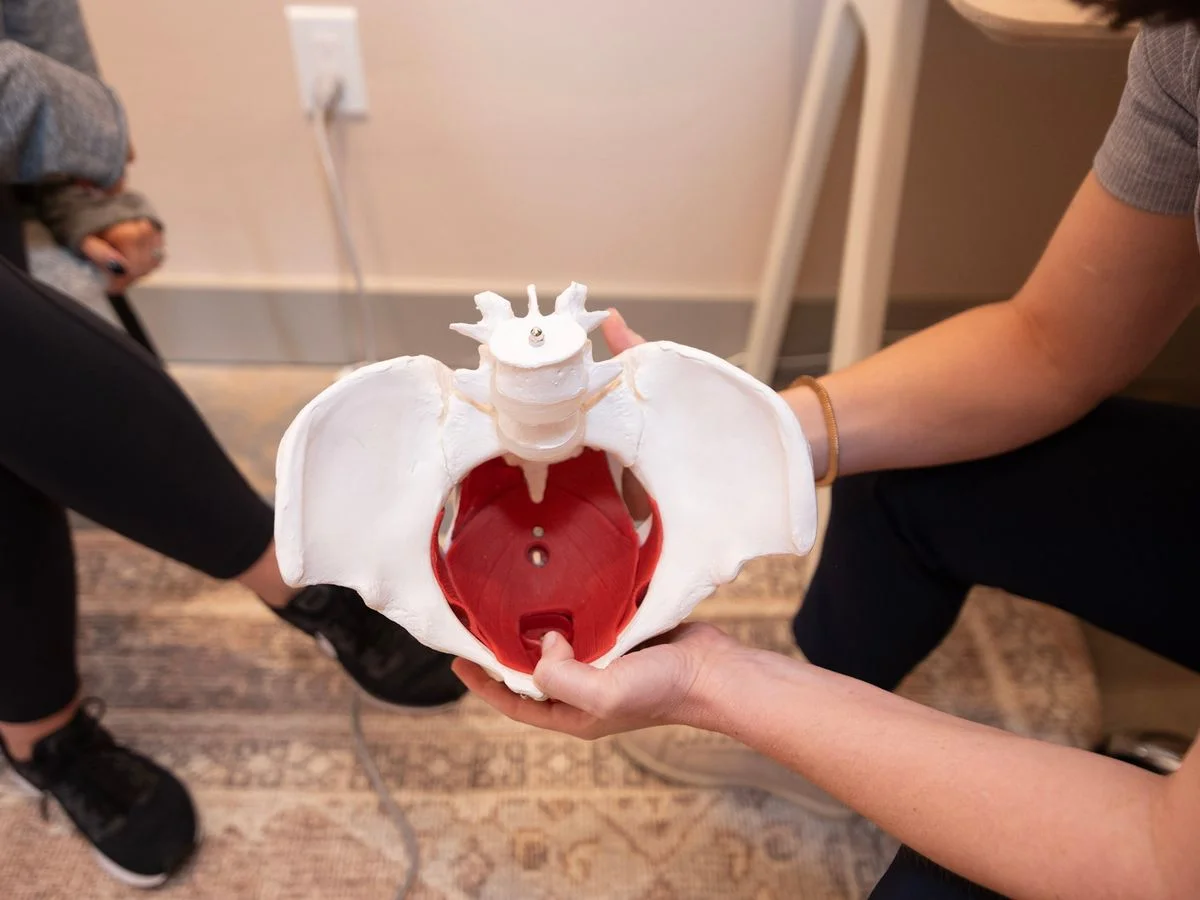
What Is Pelvic Organ Prolapse?
Pelvic organ prolapse happens when the muscles, ligaments, and connective tissue that support the pelvic organs weaken or stretch — letting one or more organs (bladder, uterus, intestine, rectum) descend and push against the vaginal walls, creating feelings of pressure, or like something is in or falling out of your vagina, and often bowel or bladder dysfunction.
Common Symptoms
- A feeling of heaviness, pressure, or "falling" in the pelvis, often worse at the end of the day
- A visible or palpable bulge in or out of the vagina
- Difficulty emptying the bladder or bowel completely
- Urinary urgency, frequency, or stress incontinence
- Constipation or feeling the need to "splint" (use a finger) to fully empty
- Lower back ache that worsens with prolonged standing
How We Treat Prolapse
1. Thorough Evaluation
Your first visit is a full 60 minutes. We assess the prolapse, assess pelvic floor strength and coordination, evaluate breath and core integration, check posture and movement patterns, and discuss your symptoms and goals. We also look at lifestyle factors — chronic coughing, constipation, heavy lifting form — that may be contributing.
2. Pelvic Floor Strengthening and Coordination
For most prolapses, the foundation of treatment is rebuilding the pelvic floor's strength and coordination. This isn't just kegels. We teach you how to properly engage the right muscles, how to relax them when they need to, and how to integrate them into daily activities — getting out of bed, picking up your child, lifting a grocery bag.
3. Pessary Coordination (When Appropriate)
A pessary is a soft, removable device that physically supports prolapsed organs from inside the vagina. For many women, the right pessary dramatically reduces symptoms — often immediately — and lets them stay active and comfortable while pelvic floor PT does its longer-term work. We connect you with the right specialist, communicate with them directly, and integrate your pessary into your PT plan.
4. Breath, Core, and Posture
Pressure management is everything in prolapse. We teach you how to breathe, brace, and load without driving pressure down into your pelvic floor. Most women have never been shown this — and it changes everything.
5. Lifestyle Coaching
Constipation, chronic cough, and certain lifting techniques can perpetuate or worsen prolapse. We work on these directly. Often a few tweaks here matter as much as the strength work.
What Your First Visit Looks Like
Your first visit is a full 60 minutes, one-on-one. We start with your story: when the heaviness or pressure shows up, what makes it worse — end of the day, lifting, standing, straining — and what makes it better. Those patterns matter clinically, and most women have never been asked about them in detail.
Then we assess the whole body — breath mechanics, core strategy, back, hips, and how you move under load — because prolapse symptoms are worsened by impaired pressure management as well as by the tissue itself. An internal exam lets us assess the prolapse, identify which organ is descending, and assess how well your muscles support it. You'll leave understanding what's driving your symptoms and what your plan is. Here's what to expect at your first visit.
Can Prolapse Be Reversed?
No — unfortunately, unless it is very small, it is not reversible. The grade or degree of the prolapse doesn't correlate directly with symptoms: some people have a very large prolapse with minimal symptoms and others may have a small one with a lot of symptoms. Significant improvement in symptoms and function occurs with physical therapy even though the degree of the prolapse doesn't usually change. We expect patients to notice some improvement within 6-8 visits, and for most patients, 3-4 months of rehabilitation for full resolution of symptoms.
Do You Have to Have Surgery?
No. Surgery is one option, but it is rarely the first option. Pelvic floor PT, pessaries, and lifestyle adjustments are first-line conservative care. Many women who were told they needed surgery have canceled it after a few months of PT. We collaborate with urogynecologists when surgery is the right answer — but we'll always exhaust the conservative options first.
Frequently Asked Questions About Pelvic Organ Prolapse
Is prolapse just a normal part of having kids or getting older?
It's common — and common is not the same as something you have to live with. Too many women are told to "wait and see" or simply accept it. Conservative treatment exists, it's evidence-based, and the earlier you address symptoms, the more options you have.
Will exercise make my prolapse worse?
Movement is not the enemy — unmanaged pressure is. Once you learn to breathe and brace without driving pressure down into the pelvic floor, most activities can be modified and reintroduced. Blanket "never lift anything heavy again" advice isn't supported by evidence, and giving up activity entirely carries its own costs.
Can you fit me for a pessary?
We don't fit pessaries in-house — deliberately. A well-managed pessary needs routine physician monitoring of the vaginal tissue over time, so we coordinate fitting with trusted urogynecologists and integrate the pessary into your PT plan. Over-the-counter support options are listed on our resources page.
Why are my symptoms worse at the end of the day?
Gravity plus fatigue. Your support system — pelvic floor, deep core, connective tissue — has been managing pressure all day, and by evening it's tired, so heaviness becomes more noticeable. That pattern is classic prolapse, and it's also useful: it tells us where positioning, pacing, and strength work will pay off first.
Does Medicare cover pelvic floor PT for prolapse?
Medicare patients are welcome here. We're a non-participating provider, which means you pay at the time of your visit, we submit the claim to Medicare for you, and Medicare reimburses you directly. For other plans, we submit out-of-network claims automatically, and HSA and FSA funds apply.
I've never had children — why do I have prolapse?
Childbirth is the most familiar risk factor, but not the only one. Chronic constipation and straining, a chronic cough, heavy lifting with poor pressure mechanics, tissue changes with menopause, and prior pelvic surgery can all contribute. The treatment logic is the same: reduce the load, improve the support.
Related Conditions
Prolapse often overlaps with: