
What Is the SI Joint?
The sacroiliac joints are where the sacrum (the triangular bone at the base of your spine) meets the iliac bones (the upper part of your pelvis). They're small, very stable joints with limited motion, supported by some of the strongest ligaments in the body. When they're working well, you don't think about them. When they're not, they cause pain that can be sharp, deep, and difficult to localize.
Symptoms
- Pain at the dimples just above the buttocks (PSIS), often one-sided
- Deep buttock pain
- Pain radiating into the hip, groin, or back of the thigh (rarely below the knee)
- Pain with prolonged sitting or standing
- Pain rolling over in bed
- Pain going from sitting to standing
- Pain with single-leg activities (climbing stairs, putting on pants)
- A feeling of the pelvis "giving way" or being unstable
Common Causes
- Pregnancy and postpartum (hormonal ligament laxity + birth mechanics)
- Falls onto the buttocks
- Repetitive single-leg loading (running, dance, lifting on one side)
- Hip mobility restrictions that overload the SI joints
- Lumbar spine fusion (changes load distribution)
- Hypermobility / connective tissue conditions
- Weakness of deep stabilizers (pelvic floor, core, glutes)
Why General PT Often Misses It
Many patients with SI joint pain go through rounds of standard PT focused on the back or hip, with modest improvement. The reason: the SI joint is stabilized by a network that includes the pelvic floor, deep core, and gluteal system — not just the muscles around the joint itself. Without assessing and addressing the full network, treatment plateaus.
How We Treat It
1. Comprehensive Assessment
We evaluate SI joint mobility, hip mobility, lumbar function, pelvic floor activation and coordination, gait, and movement patterns. The full picture tells us where the load is poorly distributed.
2. Manual Therapy
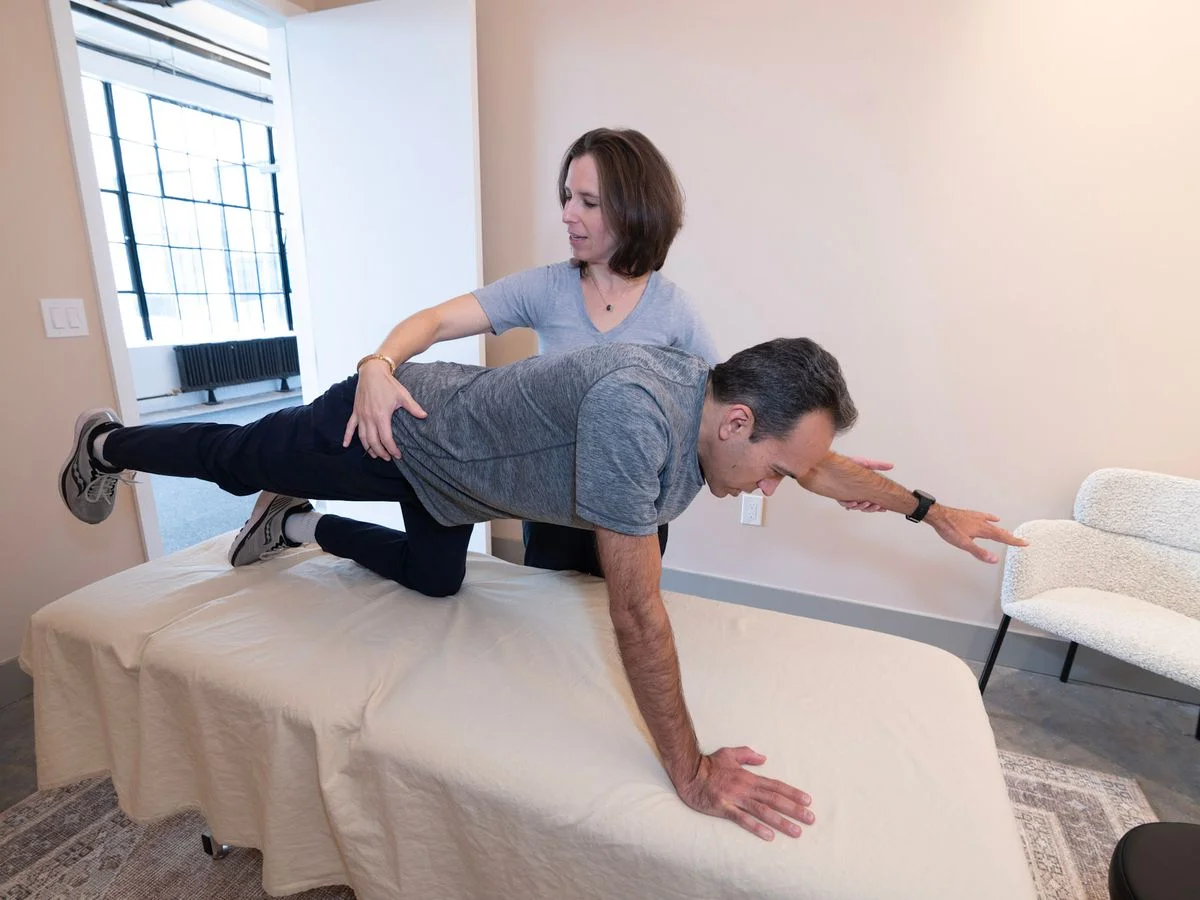
Gentle joint mobilization, muscle release (often including the pelvic floor), and soft tissue work to calm acute pain and restore mobility.
3. Stability Retraining
Once symptoms calm, we build the deep stabilizing system: pelvic floor, transverse abdominis, multifidus, and glutes — coordinated to support the SI joints during real-world loading.
4. Movement Correction
We identify and correct the daily and athletic movements that overload your SI joints — how you sit, how you lift, how you run — so the gains hold.
5. Supportive Tools (When Helpful)
For some patients, an SI belt or pregnancy support garment can dramatically reduce pain during the acute phase. We help you decide if and when it makes sense.
What to Expect
Most SI joint patients see meaningful change in the first 3-6 visits. Long-term resolution (no recurrence) typically takes 2-4 months of consistent work to build the stability that keeps symptoms from returning.